


Brian Douglas
Not very long ago, I reviewed GMC’s Sierra Denali 1500 pickup, and since its MSRP was an eye-popping $87,385 with options, I assumed this was about all one could lavish on a truck — at least when powered by petrol. But the GMC premium brand offers more. A Sierra EV Denali will set you back at least $98,400, and if you’re toting additional disposable income, GMC’s electric Hummer starts purring at $108,650. Few owners will haul yard waste in one of these fancy critters.
Just when I thought Denali was GMC’s top trim level, a 2025 Denali Ultimate arrived for testing with a window sticker of $87,405 all in. It appears that the Ultimate hierarchy avoids that struggle of choosing the $15 grand of options that populated our previous pickup.
Some of us remember the time when an automotive “luxury” stipulation applied to big, posh sedans and grand touring sports cars. But as light trucks grew in popularity, marketing maestros recognized an opportunity to cash in. Back in 2001, Lincoln took its Blackwood concept, a lovely pickup with a wood-finished bed and hard cover, and offered it for sale for $52,500. My review at the time found it perfectly useful for tailgating parties and picking up a few cases of nice wine for the cellar. That’s not a robust market, so Lincoln returned to cars and SUVs in 2003. But they took another shot at truck luxury a few years later with the Lincoln Mark LT, a gussied-up Ford F150. It carried a not unreasonable $38,615 price, just a grand more than Ford’s King Ranch model, but Lincoln’s legacy had little to do with trucking so sales were rather modest.
Meantime, brand virtuosos at Cadillac thought it would be a swell idea to convert Chevrolet’s Avalanche, an offering that could double as a tall sedan or pickup depending the owner’s requirements. The Caddy version’s opening price of $51,215 was a $20 grand premium over the Chevy and Cadillac’s luxury heritage, like Lincoln’s wasn’t based in a legacy of hauling.
All this history made me consider brand value and luxury attributes. For instance, in Ford Motor Company’s brand portfolio, Lincoln is the luxury moniker, yet the most expensive offering I could locate was the $121,485 Navigator L Black Label. On the other hand, Ford’s new Mustang GTD will set you back $325,000. The Ford GT sports car was $500,000 during its recent limited appearance in the marketplace and the last track edition models sold for $1.7 million. It begs the question of what brand defines premium.
Over at GM, Chevrolet looked like the price titleholder with Corvette’s ZR1 model beginning at $205,000. And it might have kept that stature but Cadillac responded with its Celestiq, a built-to-order electric sedan with a base price of $340,000. That’s a pretty cool Caddy, and I’m trying to decide whether Vixen Metallic or Siku Tricoat is the best exterior color. What do you think?
Back in what may be reality for most of us, the democratization of what I’d call trickle-down luxury means that we can get all the posh and polish we wish for in nearly any brand if we don’t care what statement the badge makes. Meantime back to luxury pickups, rivals for the GMC Sierra Denali Ultimate include the RAM Tungsten and Ford’s King Ranch.
THE FINE PRINT
2025 GMC Sierra Denali Ultimate
TYPE: Front-engine, four-wheel drive
ENGINE: 6.2-liter V8
HORSEPOWER: 420 at 5,600 RPM
TORQUE: 460 lb.ft. at 4,100 RPM
BASE PRICE: $84,200
AS TESTED: $87,405
FUEL CONSUMPTION: 15 city, 19 highway, 16 combined
Brian Douglas has driven everything with wheels during his career in automotive technical, marketing and journalism professions. If you have a question or story to share, he can be reached at brian@autoeditor.com
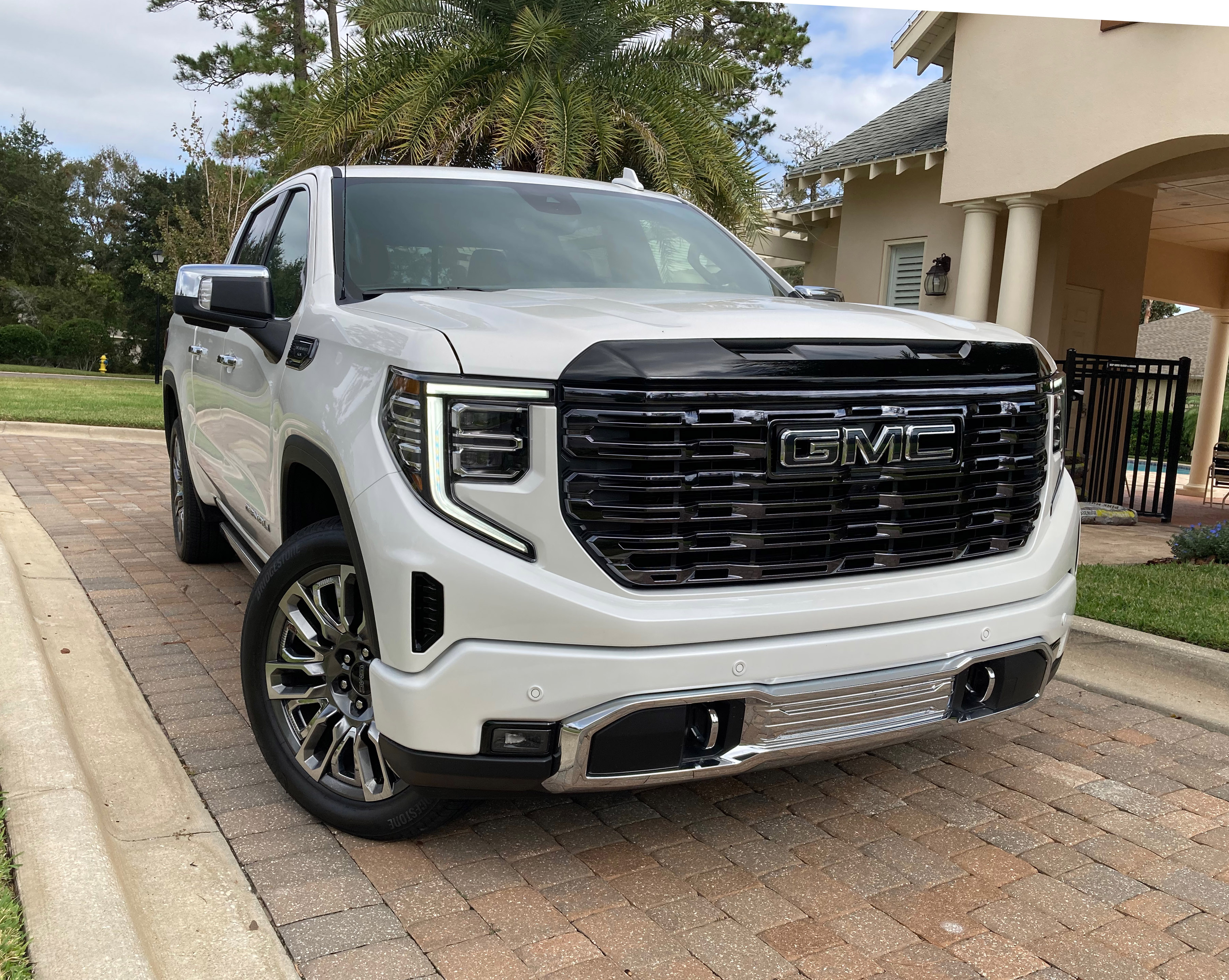
The Ultimate isn’t for hauling yard waste. Photo courtesy B. Douglas/Autoeditor
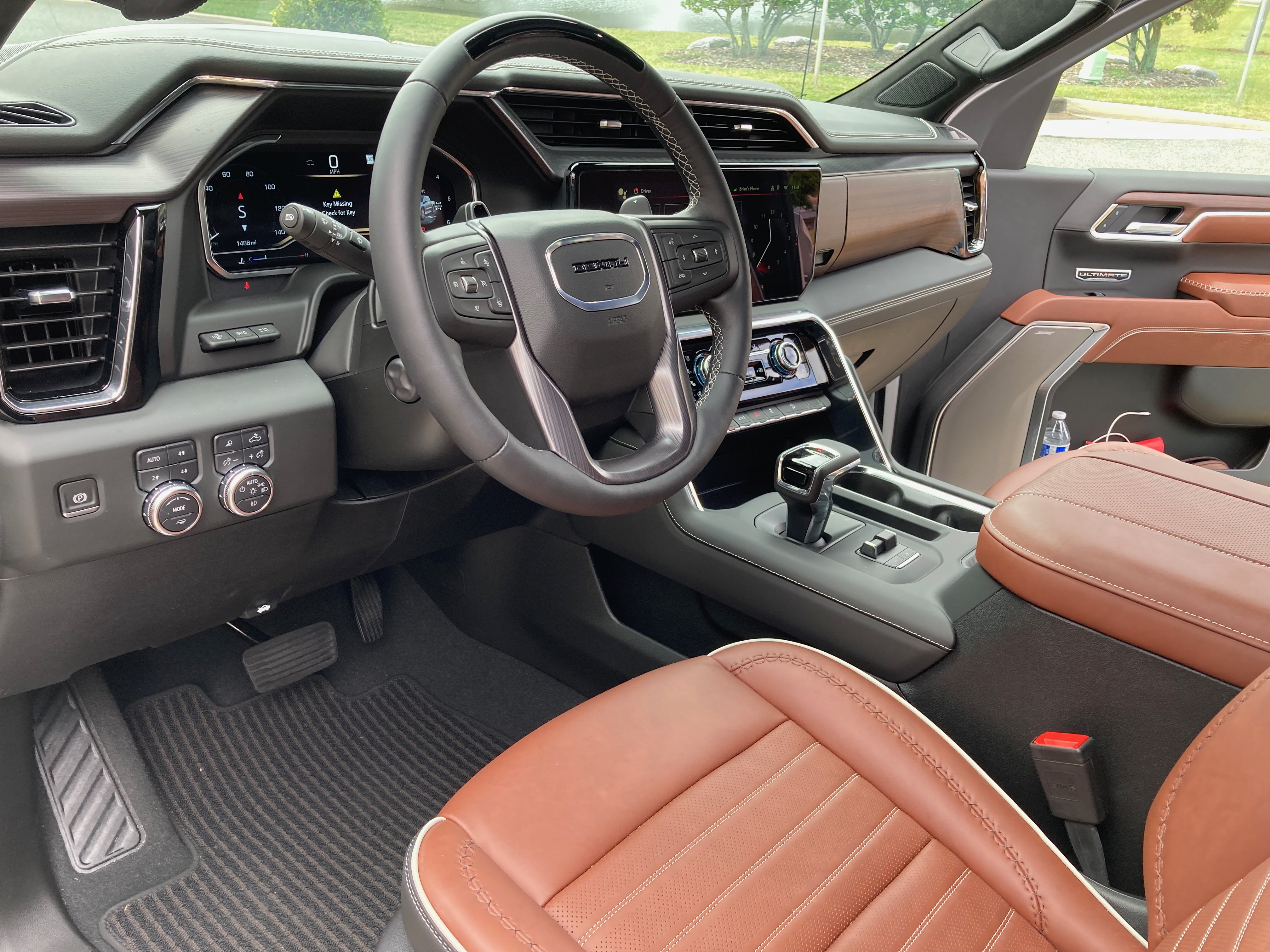
The Ultimate isn’t for hauling yard waste. Photo courtesy B. Douglas/Autoeditor