

The Nassau County School District’s inaugural public hearing on a textbook objection took place May 20, ending without a resolution.
Jack Knocke, executive director of Citizens Defending Freedom (CDF), filed a formal complaint against a world history textbook, published by SAVVAS Learning LLC, approved by the Florida Department of Education and Nassau County School Board for 10th-grade world history classes.
The basis for the objection, according to the petition, being “the material is not suited to student needs and their ability to comprehend the material.”
Nassau County School District (NCSD) attorney Brett Steger presided over the hearing along with hearing officer Sharyl Wood. The Nassau County School Board was present to review and listen to the evidence presented, both verbal and documentary.
“Today’s issue is a continuation of clean-up of woke, DEI (diversity, equity and inclusion), racist content in our public schools,” said Knocke in his opening statement. “Our objections relate to inappropriate, inaccurate, non-scientific information being presented as scientific fact. We don’t want to confuse, manipulate or indoctrinate students with woke, social or political ideology.”
Mark Durham, assistant superintendent and representative for the Nassau County School District, said in his opening statement, “The publisher (of the world history textbook) SAVVAS is compliant with all Florida Department of Education guidelines and rules. We will provide evidence to the board that the process we follow for textbook adoption is done according to local and state policies. We will also provide evidence that the textbook chosen is on the state-approved list, which means it went through a rigorous approval process.”
For more than an hour, Knocke issued a variety of specific challenges, including the claim that evolution is merely a theory and should not be presented as scientific fact in the world history textbook, advocating instead for the inclusion of creation as described in the Bible. He argued that the world history textbook unfairly overshadows Judeo-Christian beliefs and he expressed strong opposition to the online resources supporting the textbook due to the presence of artificial intelligence.
Because the hearing coincided with a previously scheduled regular Nassau County School Board workshop, Durham had the option to either present in the remaining 10 minutes or reschedule. Durham chose to present.
Durham described the rigorous process that the Florida Department of Education, school districts and teachers go through to decide which book publishers and textbooks are best for students.
“What this hearing really comes down to is, this process which is required by the statute, after a long process of textbooks being vetted by the state, brought to the districts so our teachers can evaluate them and decide which textbooks they think are the best for our students, after that is done and our board has actually voted and adopted the materials, this is why we are here today,” said Durham as he began his presentation.
Durham explained the four statutes used to review books. If one or more of these statutes are found within a textbook, a challenge can be initiated:
- The material is pornographic.
- The material is prohibited under Section 847.012, F.S. (the obscenity statute)
- The material depicts or describes sexual conduct as defined in Section 847.001(19), F.S.
- The material is not suited to student needs and their ability to comprehend the material.
Knocke and CDF based their objection on statute No. 4. Durham explained to the hearing officer and the school board that the world history textbook is to be reviewed based on “the material not being suited to student needs and their ability to comprehend the material.”
“It’s not an argument of philosophy or what ideologies we believe in. We have a State Board of Education that says what materials are appropriate and what materials are inappropriate,” said Durham in his final statement. “We’ve gone through the process, we did it the way it’s outlined in the state guidelines, and the textbook is appropriate and suitable for our students in world history.”
The News-Leader asked school district attorney Steger for details on what happens next in the objection process following the hearing. He commented that “the hearing was for the sole purpose of hearing Knocke’s objection and the (school) district’s response. After all of the evidence (testimony and documentation) has been presented, the hearing officer will consider all of the evidence and arguments and make a recommendation to the school board as to whether she believes the objection should be sustained or denied.”
“If the recommendation is to sustain the objection, that means the hearing officer would recommend that the board not use the subject textbook. If the recommendation is to deny the objection, that means the hearing officer would recommend that the board proceed with the textbook selected,” explained Steger.
“The hearing officer’s recommendation is simply that, a suggestion,” explained Steger. “The board ultimately will vote on whether the objection is sustained or denied. The board will vote on the matter in a public hearing, which will most likely be a regularly scheduled board meeting. At that meeting, the public will be afforded an opportunity to make public comment before the matter is voted on by the board.”
Ultimately, the public will be allowed to make public comment before the school board makes its decision. Instead of taking public comments during the time-limited objection hearing, the public comment session will occur prior to the board’s vote.
The public has been told to watch the school district website (www.nassau.k12.fl.us) for a scheduled conclusion. This will give the school board the time it needs to review the material presented by both parties. A vote is expected at the next meeting.
tdishman@fbnewsleader.com
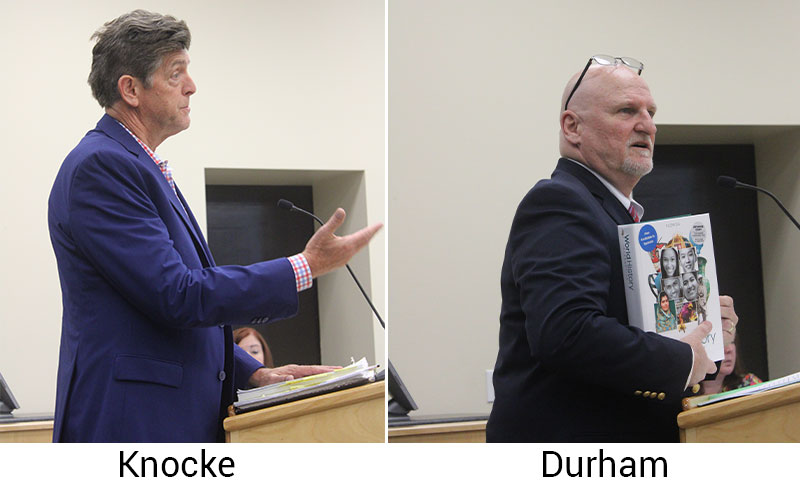
Jack Knocke, representing Citizens Defending Freedom, and Mark Durham, representing Nassau County School District, offer opening statements in textbook challenge hearing. Photos by Tracy McCormick-Dishman/News-Leader