

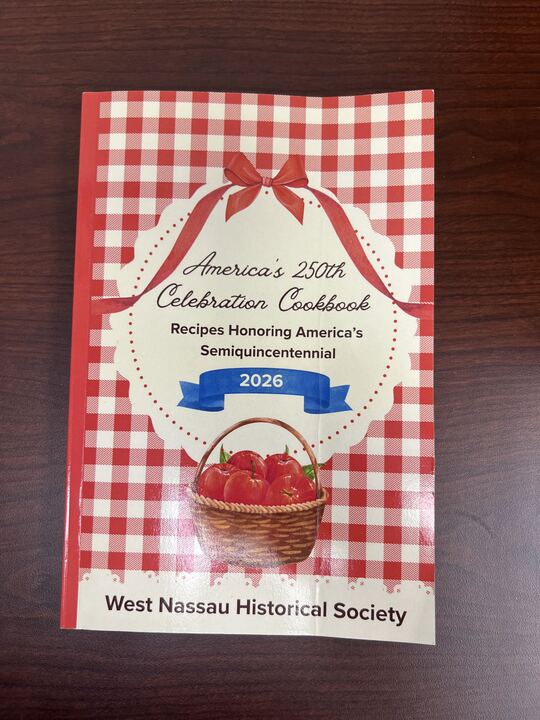
West Nassau Historical Society published a cookbook that explores America's history through recipes.
As America prepares to celebrate its 250th birthday, the West Nassau Historical Society is inviting residents to explore the nation's history one recipe at a time.
The organization's newly revised cookbook, created in conjunction with its Smithsonian-affiliated food and culture exhibit, blends local traditions with the broader story of American cuisine. The project grew from the society's participation in the Smithsonian Institution's Museum on Main Street program and a statewide initiative sponsored by Florida Humanities.
The cookbook is an updated version of a community recipe collection first published around 2006 as a fundraiser for the all-volunteer nonprofit. While many favorite recipes from the original edition remain, new additions were uncovered during two years of research for the exhibit, "Nassau = Food + Culture: What We Each Bring to the Table."
"We started research for the exhibit two years ago," said John Hendricks of the West Nassau Historical Society. "The exhibit is about the food and culture of Nassau County. We decided to do the history of food in Nassau County — farming, shrimping and other local food traditions."
As researchers explored topics ranging from dairy farming and poultry production to rice cultivation and shrimping, they began collecting recipes connected to those stories.
"Part of the exhibit has a QR code with a recipe," Hendricks said. "When members decided to redo the cookbook, they said, 'Why not put the exhibit recipes in there?' That's what we did."
The result is a cookbook that celebrates both local heritage and America's culinary journey.
Reconstructed by Ashley Gilbert, the book embraces the nation's upcoming semiquincentennial with a patriotic theme. Its 13 chapters serve as a nod to the original 13 colonies, with each chapter offering historical context alongside recipes.
Readers can trace the evolution of American food through chapters such as Colonial Kitchens, Revolutionary War Kitchens, Pioneer and Homestead Favorites, and Immigrant Influences. Other sections highlight wartime cooking, Southern gardens, Florida coastal cuisine, church suppers and holiday celebrations.
"Together, these 13 chapters tell the story of American cooking — one shaped by resilience, diversity and tradition," the cookbook notes. "They remind us that food is more than nourishment; it is a reflection of history, culture and community."
If you’re a little skeptical about making Hard Tack or Pease Porridge as part of dinner, the book offers a few “Modern Twists” to help enjoy those recipes a little more.
Many of the recipes have already made their way back to local dinner tables.
For one historical society meeting, members were encouraged to prepare dishes from the cookbook.
"I made a mild version of dirty rice," Hendricks said. "Someone made blueberry cobbler, and of course we had shrimp as well."
The cookbook also complements the society's exhibit, which examines how generations of settlers, immigrants, farmers, fishermen and entrepreneurs shaped Nassau County's food culture. One section explores the area's shrimping industry and the history of local shrimp boat builders, including the Smith family of Fernandina Beach.
To support that effort, the society recently welcomed local historian Nick Deonas to discuss the history of the Smith boat-building industry.
The cookbook's release comes as visitors continue exploring the Smithsonian-inspired exhibit, which remains on display through Dec. 12 at the historic Train Depot in Callahan.
Unlike traditional traveling exhibits, the Museum on Main Street pilot program allowed each participating organization to research, design and build its own exhibit focused on local food traditions. Seven sites across Florida are participating, each highlighting a different aspect of the state's culinary heritage.
The West Nassau Historical Society's exhibit was developed in collaboration with the Smithsonian Institution and Florida Humanities, with local sponsorship provided by Rayonier and Florida Power & Light.
The cookbook is available for purchase through Amazon and at the West Nassau Historical Society's Train Depot Museum, located at 45383 Dixie Ave. in Callahan.
For Hendricks, the cookbook and exhibit share the same goal: preserving the stories behind the meals that have brought generations of Nassau County residents together.
From colonial hearths to shrimp boats and family reunions, every recipe tells a story — and together they help tell the story of America.